How to Store Cards in Toploaders (Without Losing Them)
Learning how to store cards in toploaders is the easy half. The hard half arrives about two hundred cards later, when the toploaders themselves become the problem.
Learning how to store cards in toploaders is the easy half. The hard half arrives about two hundred cards later, when the toploaders themselves become the problem.
A rigid toploader is excellent at what it does: it stops bends and it protects corners. What it does not do is tell you what is inside it, or stay where you put it.
This is what changes once the pile gets big enough to matter.
What storing cards in toploaders actually solves
A penny sleeve stops surface scratches. A toploader stops the card bending and takes the impact that would otherwise land on a corner. Those are different jobs, which is why the sleeve goes inside the toploader rather than instead of it.
What the toploader leaves open is everything above the level of a single card. A hundred toploaders in a box are a hundred rigid objects with nothing organising them, and rigid objects in a box slide.
That sliding is the mechanism behind most storage damage. Not one dramatic event, but a small motion repeated every time the box is moved.
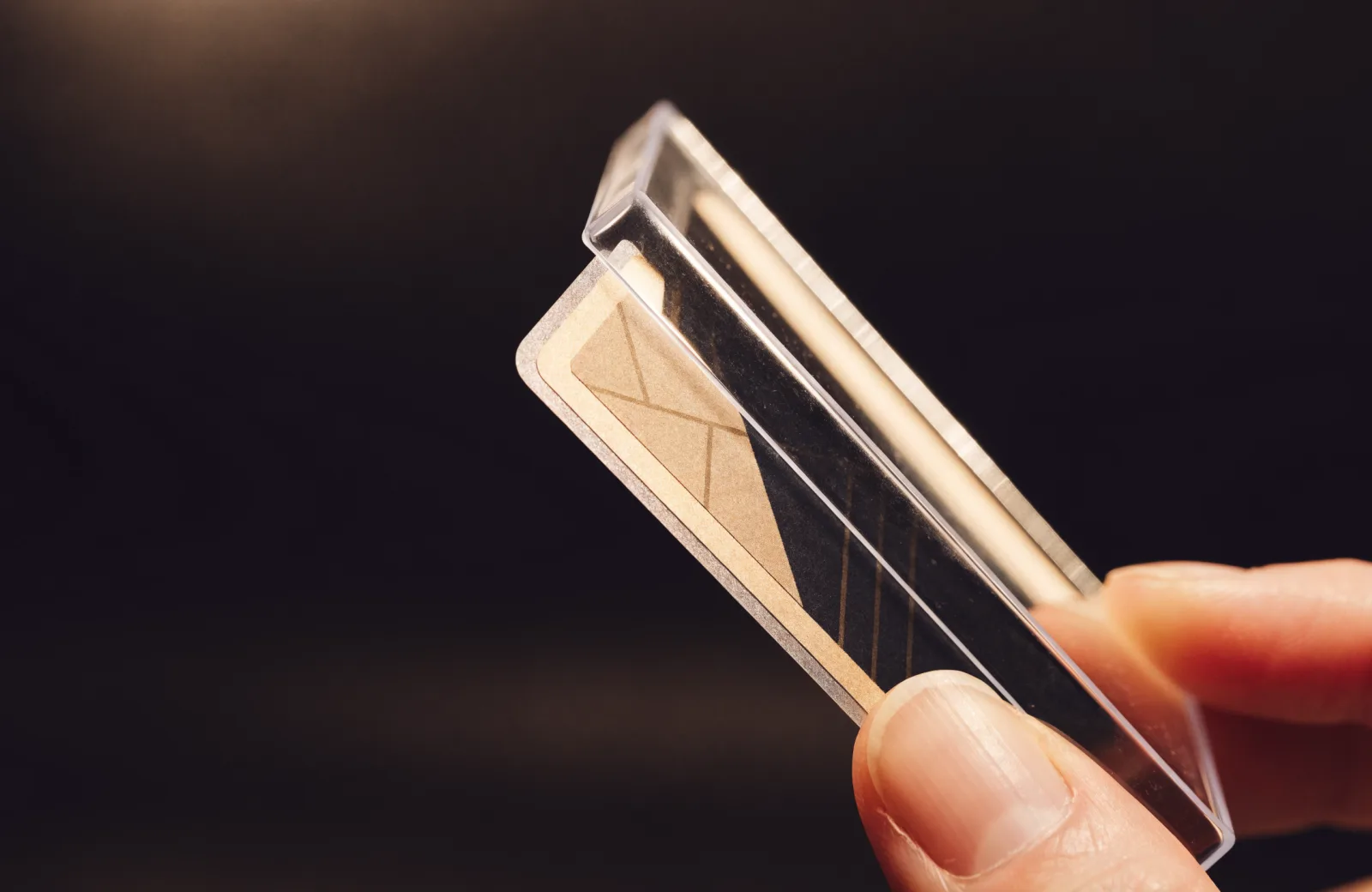
The filing problem toploaders create
Once cards are in toploaders, most binders stop being an option. Standard binder pockets are cut for a card in a soft sleeve, which is a markedly thinner object than a card in a rigid case.
That leaves the common and unsatisfying compromise: protect the card properly and keep it in a box, or file it in a binder and take it out of the toploader to do so.
It is a false choice, and it exists entirely because of pocket depth.
What a binder needs before it can take toploaders at all:
- Pockets cut for the depth of a rigid toploader, not a soft sleeve
- Side-loading pockets, so a toploader is held square rather than free to drift
- Non-tenting pages, so a full binder still lies flat instead of wedging open
- No rings, because a ring mechanism presses the cards nearest the spine
- A closure that seals more than one edge if the binder ever leaves the house
Storing toploaders so they stay findable
Findability is a protection feature, not a convenience one. A collection you cannot search is a collection you handle more, and handling is when damage happens.
Double-sided pages help here in a way that is easy to underrate: 9 pockets per side means a page carries 18 cards, so a given number of cards sits in fewer physical pages and takes fewer movements to search.
The practical target is being able to find a specific card without unstacking anything.
Travelling with toploaders
Everything above assumes a shelf. A bag changes the requirements, because gravity stops helping and every unsecured edge becomes an exit.
A case that zips on three edges holds its contents regardless of orientation, and a shell that repels water turns the two most common show hazards - a knocked drink and a walk through rain - into non-events.
How many toploaders is too many to leave loose
There is a threshold most collections cross without noticing. Below roughly fifty toploaders you can keep them in a box and still find things, because you remember roughly where you put them. Past that, retrieval turns into a search, and every search means handling cards you did not intend to handle.
Handling is where damage happens. Not dramatic damage, but the accumulating kind: a corner catching the lip of a box, a stack sliding as you pull one out, a case landing face-down on a table. None of it registers as an incident. All of it shows up later as edge wear on cards you would swear you had never touched roughly.
The practical marker is simple. If you have to move cards you are not looking for in order to reach the card you are looking for, your storage has stopped protecting and started costing. That is the point at which pages earn their place, because a page lets you find a card by looking rather than by digging.
What changes when toploaders go into pages
A pocket sized for a toploader holds the case rather than the card, which means the card is never in contact with the pocket at all. The toploader takes the friction and the card sits inside it untouched. That is a different arrangement from a standard binder pocket, where the card and the sleeve rub against the pocket every time the page turns.
It also changes what happens when the binder is full. Toploaders are rigid and roughly a millimetre and a half thick, so a page carrying eighteen of them across both sides is holding real bulk. A binder designed around that closes flat. A binder designed around bare sleeves and then filled with toploaders bulges at the spine, and the pages nearest the outside take the strain.
This is the reason capacity is quoted in toploaders rather than in cards on a binder built for them. Two hundred and sixteen cards in sleeves is a much smaller object than two hundred and sixteen cards in toploaders, and only one of those numbers tells you whether the thing will shut.
One consequence worth planning for: a binder built for toploaders will feel half empty when you first load it with sleeved cards, and completely full at a lower card count than the number on the box suggests if you later switch to cases. Decide which format the collection is going to live in before choosing capacity, because the two numbers are not interchangeable.
Common questions
- Should I put a sleeve inside a toploader?
- Yes. The sleeve stops surface scratches and the toploader stops bends and corner impact. They solve different problems, so the sleeve goes inside rather than instead.
- Can toploaders go in a normal binder?
- Usually not. Standard pockets are cut for a card in a soft sleeve, which is thinner than a card in a rigid toploader. The binder has to be built for the depth.
- Is a box fine for storing toploaders?
- It protects against impact but not against movement, and movement repeated over months is what produces soft corners and edge wear.
Knowing how to store cards in toploaders eventually stops being a question about the card and becomes a question about what holds the toploader, which is the point most collections reach without noticing.
Keep reading
- why the rings came out of the binder
- five storage mistakes that cost grades
- when two binders beat one
- why we built a 288
- why the shell is scratch resistant
- the InfinityVault 216-card toploader binder
- how card protection layers
- more from the workshop