Ringless Card Binder: Why We Took the Rings Out
A ringless card binder starts from an uncomfortable admission: on most binders, the mechanism holding the pages in is the part most likely to damage what is inside them.
A ringless card binder starts from an uncomfortable admission: on most binders, the mechanism holding the pages in is the part most likely to damage what is inside them.
Three-ring binders were never designed for trading cards. They were designed for paper, which does not mind being punched, and which does not lose value when a corner is pressed. Cards mind both.
This is the story of what we found when we took the rings out, and the four things that had to change once they were gone.
What a ringless binder actually solves
A three-ring mechanism sits proud of the page. When the binder closes, the cards nearest the spine press against it. That pressure is small and constant, which is the worst combination — it does not announce itself the way a drop or a spill does. It accumulates over months, and it shows up as a dented corner on the card you least wanted dented.
The second problem is the ring's footprint. A ring binder holds pages that must clear the mechanism, so the pages sit at slightly different depths depending on where they are in the stack. Cards near the rings sit deeper. Cards at the outer edge sit shallower. The binder closes unevenly, which is why a full ring binder wedges open at the spine.
Take the rings out and both problems disappear at once. There is nothing inside to press a card, and nothing forcing the pages to sit at different depths.
The problem that appears the moment the rings are gone
Removing the mechanism creates a new question: what holds the pages in, and does the binder still close when every pocket is full?
This is where most ringless designs quietly fail. A binder can be ringless and still tent — the pages splay at the spine as they fill, the covers stop meeting, and the zip either strains or will not close at all. Ringless is not the same as flat.
Pages had to be non-tenting, which means they lie flat when loaded rather than wedging the binder open. It is a less obvious property than 'ringless' and it is the one that determines whether the binder still works at capacity.
Designing for toploaders, not for bare cards
Most binder pockets are cut for a card in a soft sleeve. That is a thinner object than a card in a rigid toploader, and it is the reason so many collectors end up choosing between protecting a card properly and storing it in a binder at all.
Pockets sized for toploaders solve that, but they introduce their own constraint: a toploader is rigid, so a pocket that is even slightly loose lets it drift. Side-loading pockets hold a toploader square, which matters most when the binder is tilted or carried rather than lying on a table.
The trade is honest and worth stating plainly: pockets cut for rigid toploaders are not the right home for cards in soft sleeves alone. A soft-sleeved card is thinner than the pocket expects.
What the finished specification came to:
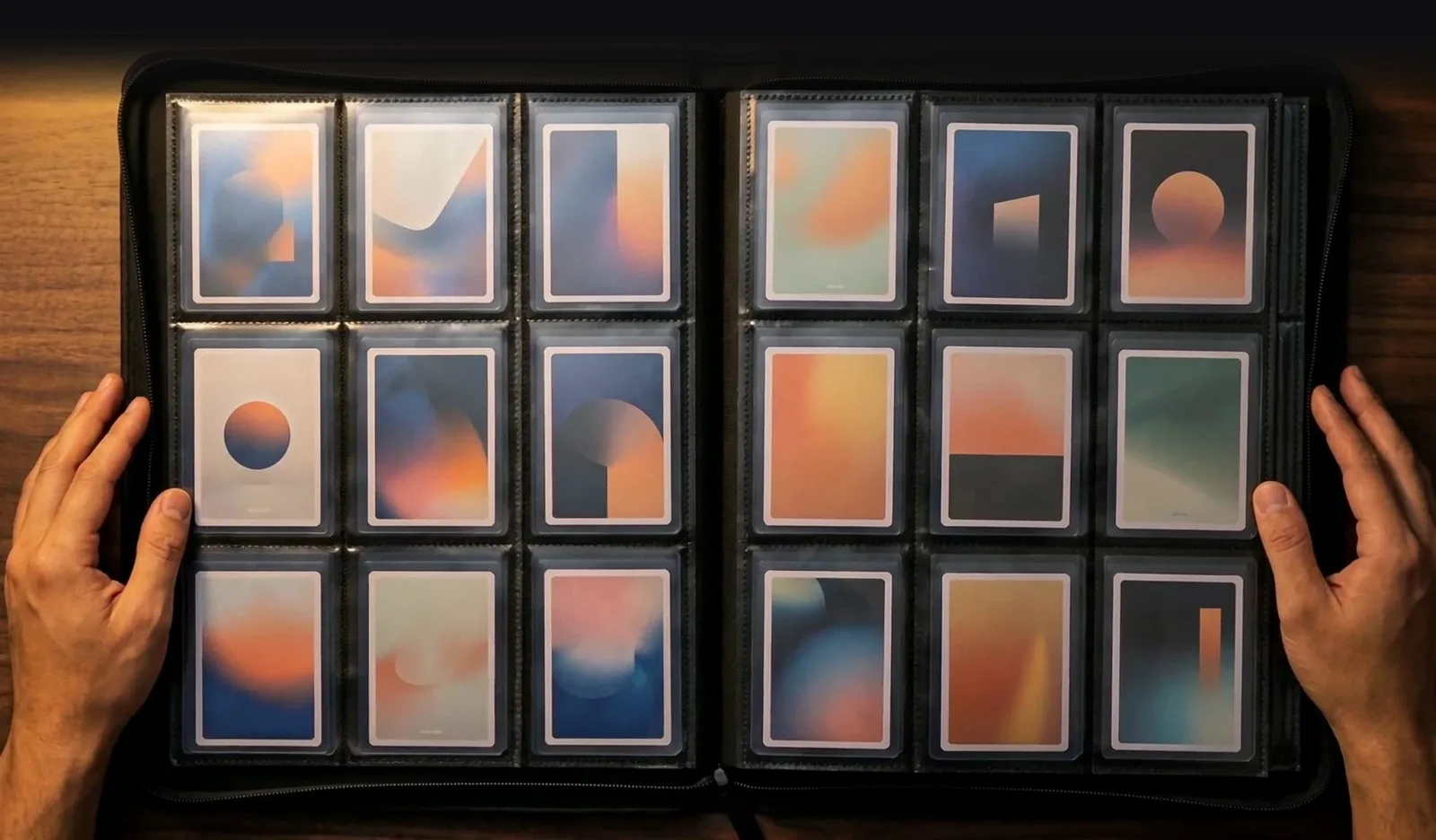
- 216 cards in toploaders, across 12 double-sided pages at 9 pockets per side
- Ringless throughout — nothing inside that can punch, pinch or press a card
- Non-tenting pages, so a full binder lies flat instead of wedging open
- Side-loading pockets sized for rigid toploaders
- A zip on all three edges, closing the binder into a sealed case
- A scratch-resistant woven shell that repels water and dust
- PVC-free materials throughout
Why the zip runs along three edges
A single-edge closure leaves two open sides. For a binder that never leaves a shelf, that is academic. For one that goes to a card show, it is the difference between a spill landing on the outside and a spill landing on the collection.
Zipping on three edges turns the binder into a closed case. Combined with a shell that repels water and dust, it means the realistic hazards of a show — a knocked drink, a walk to the car in rain — stay outside.
It also means the binder can be carried in one hand without anything shifting inside, which is the everyday version of the same problem.
What we would tell someone comparing binders
Four questions separate binders that survive a full collection from binders that do not, and they are worth asking of anyone's product, including ours.
Does it still close when every pocket is full? Is it genuinely ringless? Does the shell repel water? And are the pockets cut for toploaders, or only for bare sleeves? A binder can pass three of those and still be the wrong answer for a collection you care about.
What replaces the rings
Taking the rings out raises an obvious question: what holds the pages in. The answer is a bound spine, which is the same arrangement a book uses and for the same reason. The pages are fixed rather than removable, and the binding sits outside the area the cards occupy.
The trade is real and worth stating plainly. You lose the ability to reorder pages or add more of them, which is a genuine cost if you like rearranging a collection by set. What you gain is that no part of the mechanism ever sits over a card, which is the failure the rings caused in the first place.
Common questions
- Is a ringless card binder better than a three-ring binder?
- For trading cards, yes — a three-ring mechanism presses against the cards nearest the spine every time the binder closes, and that pressure accumulates into corner damage. Ring binders were designed for paper, which does not mind being punched or pressed.
- Do ringless binders still close when they are full?
- Only if the pages are non-tenting. Ringless and non-tenting are different properties, and a ringless binder with tenting pages will still wedge open at the spine when loaded.
- Can I use a toploader binder with cards in soft sleeves only?
- Pockets cut for rigid toploaders are sized for a thicker object than a soft-sleeved card, so a bare sleeved card sits looser than intended. It is designed for cards already in toploaders.
The rings were never the feature. They were the compromise everyone inherited from office supplies and stopped questioning, and a ringless card binder is simply what you get when you stop inheriting it.
Keep reading
- the 216-card toploader binder
- five storage mistakes that cost grades
- when two binders beat one
- why we built a 288
- why the shell is scratch resistant
- storing cards in toploaders once the pile grows
- how card protection actually layers
- common questions about toploader binders
- more from the InfinityVault workshop